Evo Slim Official Website › Blog › Three Milligrams Of Gymnema
Three Milligrams Of Gymnema: What A Token Row Is For
Two rows on this panel are three milligrams. The trials behind both used amounts between a hundred and a thousand times larger. That is worth explaining rather than either hiding or shouting about, because a small declared row is not the same thing as a dishonest one.
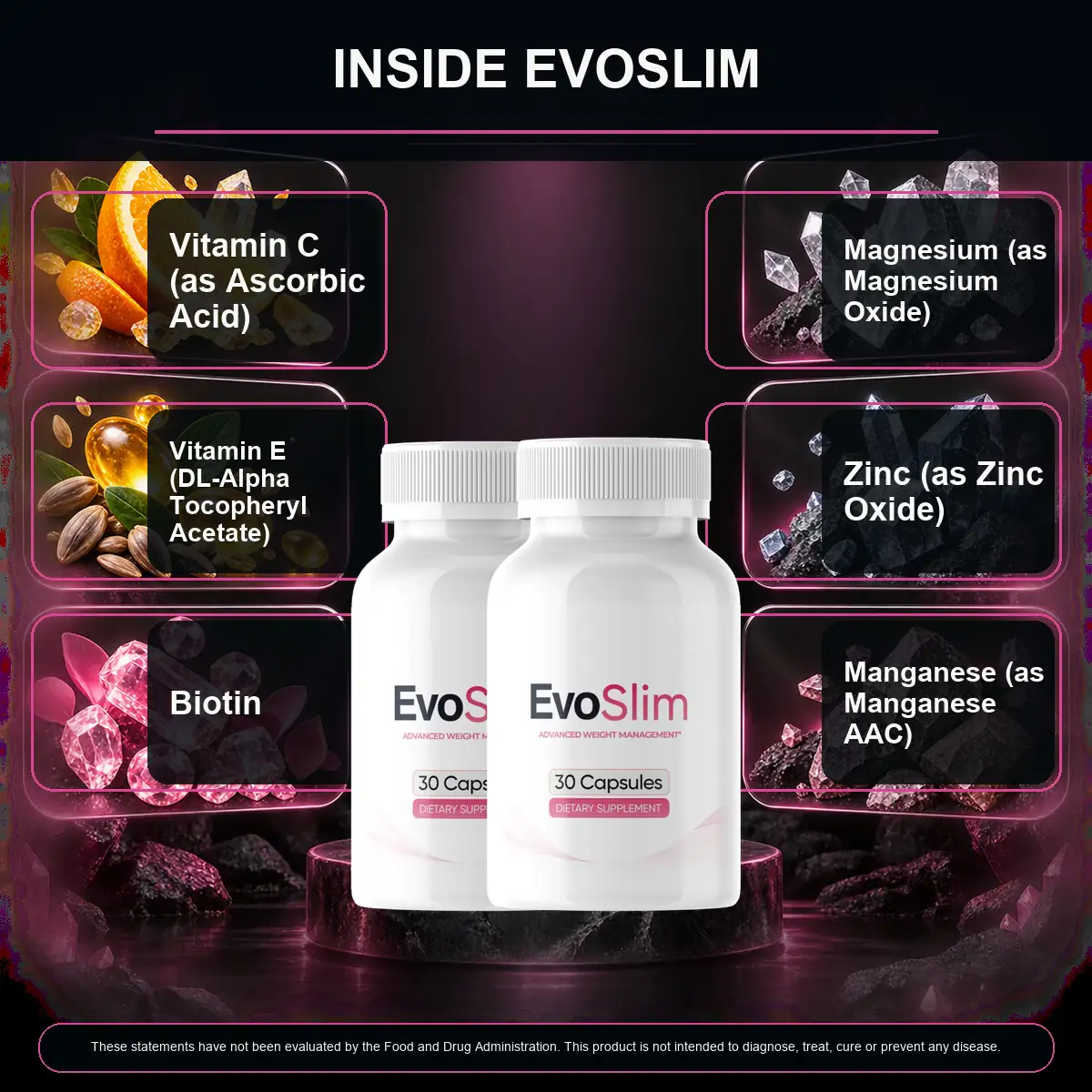
The two three-milligram rows
Thirteenth and seventeenth on the panel: Gymnema Extract (leaf) 3 mg, and White Mulberry Extract (leaf) 3 mg. Both are printed, both are declared, and neither is hidden inside a blend.
Three milligrams is a very small amount of anything. For scale, a grain of table salt is about 0.06 mg, so three milligrams is roughly fifty grains. Held in the hand it would be invisible against the 125 mg of magnesium sitting beside it in the same capsule.
The question this post exists to answer is not whether that is a lot. It obviously is not. The question is what a row like that is doing on a label, and whether printing it is better or worse than not printing it at all.
What the ratio actually is
| Row | On this label | In the published trials | The ratio |
|---|---|---|---|
| Gymnema sylvestre (leaf extract) | 3 mg | 200–400 mg a day in the pooled trials | About 1% |
| White mulberry (leaf extract) | 3 mg | 0.8–5 g of leaf powder per dose | Far below 1% |
| Bitter melon (fruit extract) | 20 mg | Around 2,000 mg a day | About 1% |
| Guggul (resin) | 50 mg | 1,000–2,000 mg a day of guggulipid | 2–5% |
| Cinnamon (bark powder) | 50 mg | 1–6 g a day of powder | 1–5% |
| Chromium | 67 mcg | 200–1,000 mcg a day | 7–34% |
Left-hand figures are read off the label artwork. Right-hand figures belong to the trials cited on the ingredients page, not to this capsule.
Read down the right-hand column and the pattern is the same one every twenty-row capsule produces: the botanical rows sit at roughly one to five per cent of their researched amounts, and the mineral row sits at somewhere between a seventh and a third.
That is not a scandal. It is arithmetic. A capsule holds a few hundred milligrams of powder in total, and twenty rows inside that ceiling cannot each be a trial dose. Any twenty-row product on any shelf faces the identical constraint.
Twenty rows into a few hundred milligrams means an average of a few tens of milligrams per row. Every multi-ingredient capsule in this category is working inside that budget, whether or not it tells you.
Why a token row exists at all
Four reasons, and they are not equally respectable.
| Reason a small row exists | Is it defensible? | What it costs the buyer |
|---|---|---|
| Coverage: a broad daily base rather than a stack of doses | Yes, if declared | Nothing, as long as the label does not imply otherwise |
| Label appeal: a longer list sells better | Commercially, yes. Clinically, no | The impression that more rows means more product |
| Physical limit: a capsule holds only so much | Unavoidable | Nothing. It is arithmetic rather than a decision |
| Marketing a trial by association | No | Everything, because the trial's result never applied |
Four reasons, and only the last one is a problem. This label does not do the last one: the bottle makes a single structure-and-function claim and names no trial.
The third reason is the honest one and it is usually the real one. The first is legitimate as long as the label does not pretend to be doing the second thing. The second is commercial and a page like this one should say so out loud.
The fourth is the one that turns a small row into a lie, and it happens by implication rather than by statement: name an ingredient, put a study logo near it, and let a reader assume the study's result travelled with the name. The NIH review of weight-related supplements describes that pattern across the whole category.
Read the Evo Slim panel before you decide
Twenty actives, an amount printed against every one, one capsule a day and 30 to a bottle. The 60-day window runs from the day you pay, so the deadline worth working to is day fifty.
Two bottles $158 · six bottles $294 · 60 days from purchase
Order Evo Slim On The Official WebsiteOne capsule a day · 30 per bottle · lot EVO-26/GO-1521
When it is defensible and when it is not
- Defensible: the amount is printed, the row is not inside a blend, and the label makes no claim that depends on the amount being larger.
- Defensible: the ingredient is there for breadth and the product is sold as a broad daily base, which is what a twenty-row capsule actually is.
- Not defensible: the amount is hidden inside a proprietary blend, so nobody can tell whether it is three milligrams or three hundred.
- Not defensible: a trial is named or shown beside a row that carries one per cent of the trial's dose.
- Not defensible: the front of the bottle promises an outcome that only the trial dose was ever tested against.
By that test this label is on the defensible side of all five. Every amount is printed, there is no blend, the bottle prints one structure-and-function claim, and no study is named or implied anywhere on the packaging. The criticism available is about dose fidelity, and this desk makes it on its own home page rather than leaving it to somebody else.
Gymnema, and the part a capsule cannot do
Gymnema sylvestre is genuinely interesting, and the interesting part is one a capsule cannot deliver at any dose.
The plant contains gymnemic acids, which temporarily block sweet taste receptors on the tongue. Chew a leaf and sugar tastes of nothing for a quarter of an hour, which is a real and startling effect. It requires contact with the tongue, and a swallowed capsule has none.
The swallowed research is a different question and a more modest one. The pooled trials of glycaemic control used 200 to 400 mg a day of leaf extract and found modest effects; a later review covering body measurements looked at the anthropometric outcomes as well. Three milligrams is not in that conversation in either direction.
What that means in practice
If sweet-taste suppression is the thing you read about and wanted, this is not the format for it, and nothing about the amount would fix that. If you want a broad daily capsule that includes gymnema among nineteen other declared rows, this is exactly that, and the label says so without decoration.
Mulberry, and the unit problem
White mulberry has the same shape of story with a different twist in it, and the twist is about units.
The compound behind mulberry leaf's reputation is 1-deoxynojirimycin, which slows the digestion of starch. The 2007 human study used food-grade mulberry powder enriched with it, at 0.8 to 1.2 grams per dose. A later dose-finding trial went higher still, using grams of leaf powder three times a day.
Three milligrams of an unstandardised extract cannot be compared with either, because the extract's concentration is not printed and because three milligrams is a thousandth of a gram whatever the concentration turns out to be.
- Both are printed, declared and outside any blend, which is the minimum a reader needs.
- Both are around one per cent or less of the amounts their published work used.
- Neither carries a standardisation percentage, so no further arithmetic is available.
- Neither is claimed to do anything on the bottle, which is the only reason the first three points are merely awkward rather than misleading.
What this desk thinks, said plainly
These two rows are the weakest part of this label, and it is better to say that here than to have a reader find it themselves and wonder what else was smoothed over.
The product they belong to is a broad daily capsule with complete disclosure and a simple routine, sold with a sixty-day window counted from purchase. That is a coherent thing to buy and this desk is happy to sell it. It is not a stack of researched doses and nobody should buy it believing that it is.
Anyone who wants the second thing should buy a single-ingredient product at a researched amount, read the trials, and give it the same eight weeks. That advice costs this desk a sale and it is the right advice.
What would change this assessment
Two things, and neither requires a new trial. A standardisation percentage on the gymnema and mulberry rows would at least make the amounts calculable, which is the difference between a small known quantity and an unknown one. And a shorter panel at larger amounts would trade breadth for testability, which is a legitimate product decision that some manufacturers take.
Neither is likely on a twenty-row capsule, because breadth is what a twenty-row capsule is for. But naming the version of this product that would score better is more useful than complaining about the version that exists, and it is the standard this desk would want applied to anything it sells.
The row-by-row version, with every trial amount printed beside every label amount, is on the ingredients page. The nine-point checklist this product is scored against in public is on the choosing a formula page.
Body weight has many inputs and some of the reasons it does not move deserve a proper assessment rather than a supplement. Nothing in this article is medical advice, nothing here is a treatment for anything, and anyone taking prescription medication should raise it once before starting any capsule.
References
- Devangan S, Varghese B, Johny E, et al. The effect of Gymnema sylvestre supplementation on glycemic control in type 2 diabetes patients: A systematic review and meta-analysis. Phytother Res. 2021;35(12):6802-6812. PMID 34467577. https://pubmed.ncbi.nlm.nih.gov/34467577/
- Zamani M, Ashtary-Larky D, Nosratabadi S, et al. The effects of Gymnema Sylvestre supplementation on lipid profile, glycemic control, blood pressure, and anthropometric indices in adults: A systematic review and meta-analysis. Phytother Res. 2023;37(3):949-964. PMID 36580574. https://pubmed.ncbi.nlm.nih.gov/36580574/
- Thaipitakwong T, Supasyndh O, Rasmi Y, et al. A randomized controlled study of dose-finding, efficacy, and safety of mulberry leaves on glycemic profiles in obese persons with borderline diabetes. Complement Ther Med. 2020;49:102292. PMID 32147046. https://pubmed.ncbi.nlm.nih.gov/32147046/
- Kimura T, Nakagawa K, Kubota H, et al. Food-grade mulberry powder enriched with 1-deoxynojirimycin suppresses the elevation of postprandial blood glucose in humans. J Agric Food Chem. 2007;55(14):5869-74. PMID 17555327. https://pubmed.ncbi.nlm.nih.gov/17555327/
- Dietary Supplements for Weight Loss: Fact Sheet for Health Professionals. Office of Dietary Supplements, National Institutes of Health. https://ods.od.nih.gov/factsheets/WeightLoss-HealthProfessional/